
The murder of George Floyd in police custody at Minneapolis has sparked anti-apartheid protests not only in the United States but also in other parts of the world. During a similar protest in Bristol, UK, protesters pulled down a statue of Edward Colston, a controversial 17th-century slave trader, and threw it into a river.
Many people in Bristol have been demanding the removal of the sculpture for a long time, but it has not been implemented.
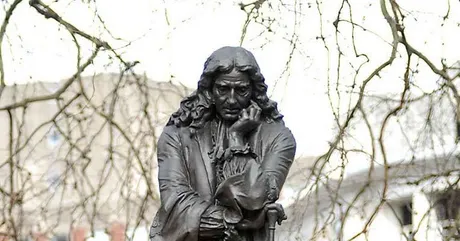 .jpeg)
Statue of Edward Colston. Source
.jpeg)
Statue of Edward Colston. Source
The incident has caused a stir in the UK, with many demanding that the sculptures of many others associated with racism and the slave trade in various parts of the UK be removed.
Who is this Colston?
Many of you may be wondering: Who is this Edward Colston, why did his sculpture cause such outrage among the people of Bristol?
In fact, the slave trade has a long history of development and prosperity in the city of Bristol, at the mouth of the River Avon in south-west England.
Edward Colston's name is involved in that slave business, and his memory has been revered for centuries in Bristol. He considered Bristol as his hometown, although he had lived in London for many years.
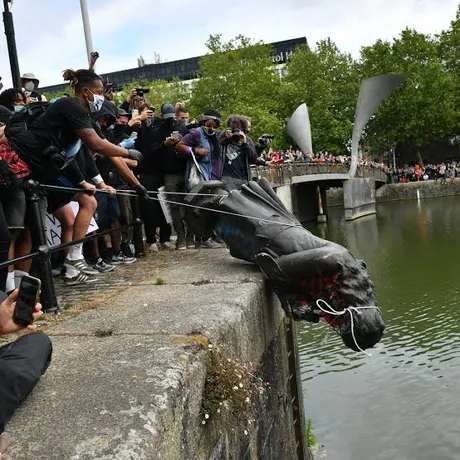 .jpeg)
Protesters drag Colston's statue into the river. Source
.jpeg)
Protesters drag Colston's statue into the river. Source
Colston, the son of a Bristol merchant family, was a wealthy man who built his fortunes on human oppression and misery.
Edward Colston was an officer of the Royal African Company. The company then had exclusive control of the slave trade in Britain. In 1689, Colston became deputy governor of the company.
That was the era of slave trade brought from Africa. It is estimated that between 1672 and 1689, about 80,000 black men, women, and children were shipped to America by Colston's ship.
These blacks were bought from West Africa. They were sealed in the name of RAC Company. After that they were shipped to America.
They were chained and laid in the hull of the ship. The captains were told that each ship could carry as many slaves as it could conveniently carry.
It took 6 to 8 weeks for a ship to cross the Atlantic from the coast of West Africa to reach America. During this time, hundreds of people had to lie in the rubble of the ship's hull. 10 to 20 percent of the people on board a ship died of disease, suicide or homicide before they reached the United States.
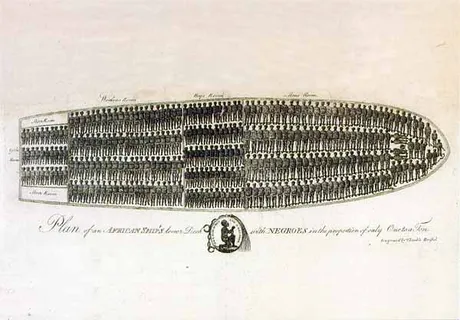 .jpeg)
This is how the shackled blacks were kept lying inside the hull of the ship. Source
.jpeg)
This is how the shackled blacks were kept lying inside the hull of the ship. Source
In addition to sending slaves to America, Colston had trade in cloth, wine, and sugar in London. He died in 1721 and donated his wealth to various charities.
He founded a school, and his money helped many more schools, churches, hospitals and the Bristol City Corporation. He was the Minister of Parliament for some time.
During his lifetime London was the center of the slave trade, but after Colston's death in 1730 and 1740 Bristol took place over London in the slave trade. From 1698 to 1807, a total of 2,100 ships sailed from Bristol to America with black slaves. Later, the city of Liverpool was also one of the centers of this business.
Colston died in London, but was buried in All Saints Church in Bristol. Several streets in the city of Bristol are named after him.
His bronze sculpture was erected on Colston Avenue in 1895, but underneath the statue he is hailed as one of Bristol's most learned child, but there is no mention of his infamous past involvement in the slave trade.
However, it was recently decided that a plaque would be erected here to commemorate his role in the slave trade.
It was also agreed to change the name of Colston Hall, which was named after him in Bristol.
However, before that, the statue was pulled down with a rope around its neck and thrown into the water.
The controversy over him in Bristol has been going on for a long time
In the words of Bristol-based poet Miles Chambers, Colston's statue in downtown Bristol always reminds him of this man's inhumanity.
Bristol has been questioning Colston's whereabouts since 1920, but was ignored until 1999.
That same year, Madge Dresser, a professor at the University of West England, spoke of Colston and his role in the slave trade.
The next day, it was seen that he had written "slave trader" on his statue - although the city authorities removed it.
Will Paul Stephenson's statue be in Bristol?
Many have demanded that the statue of Edward Colston should be replaced by the statue of Paul Stephenson, the leader of the civil rights movement of the 1960s.
In Bristol, blacks or other black minorities were not allowed to work as bus drivers or ticket conductors in the 1960s.
In protest, the bus boycott movement in Bristol was led by Dr. Stephenson, and that movement led to the lifting of that ban.
Protesters have also demanded that the statue of imperialist Cecil Rhodes should be removed from Oriel College in Oxford.
Activists say that the university has failed to address its institutional racism.
Reference:
- Translated from: BBC Bangla
Return from Why Was Bristol Slave Trader Colston So Controversial? to pitboy's Web3 Blog